Saturday, December 21, 2013


Joseph P Farrell....a treat for adult readers who love intrigue, mystery and maybe real life magic
This review is from: The Philosopher's Stone: Alchemy and the Secret Research for Exotic Matter (Paperback)
My first venture in reading Joseph P. Farrell was this book, I was stunned. I stopped to catch my breath, I loved it! There was so much about alchemy, the Nazi regime and what they were up to, the subject of red mercury, and more that caused me to wonder. I am now on The Cosmic War, by the same author and loving it.The Cosmic War: Interplanetary Warfare, Modern Physics, and Ancient Texts: A Study in Non-Catastrophist Interpretations of Ancient Leg
This review is from: The Cosmic War: Interplanetary Warfare, Modern Physics, and Ancient Texts: A Study in Non-Catastrophist Interpretations of Ancient Leg (Paperback)
I never thought I was a series reader, but this is my second by Joseph P. Farrell, and right or wrong, in spite of what some people say....this is exciting thinking, this is possible in so many ways. As a child, I often thought, if plants die in winter and return in spring, why can't we? What are we missing in the mystery of life? I constantly sought answers in books, somewhere the mystery was hidden and someone knew it. Yes, I had the thoughts also, as some of you may have thought, that once the earth had a greater civilization than we did. Then I questioned it, and then I wondered if we are so smart at this stage of the game, how did Plato and Aristotle for example and Leonardo Da Vinci, Bruneschelli etc., know so much if they lived in ancient times?Watching the seasons, the ebb and flow of the tides , the knowledge that the earth's axis changes, that climate changes, I wondered is it possible that life as we know it ebbs and flows also...So when you read Joseph P. Farrell you find a kindred soul, whose knowledge of physics, helps him take your/my thoughts a step further, by comparing these thoughts we imagine into the world we are discovering each day. Maybe we are reaching another height in civilization, where we will bring this era to an end and a new beginning will once more face us in the everlasting life scenario, we seem to enjoy. Questions, questions and thinking is what is fun...and this book is a fun book, I recommend to anyone that loves to escape into the world of thoughts .. I am on to the next one!
Wish list...Michio Kaku newest book... and Joseph P. Farrell
 |
and this one...below
| ||||||||||||||||||||

Sunday, December 15, 2013
Friday, December 13, 2013
Rainbow Gravity...sounds nice, interesting , ties in with my future book reviews maybe over Christmas..I will get to them
Huff Post does a good job catching the Science News, which I love and don't always get a chance to check on...the books I am reading now lead into this new theory....hope to get reviews up soon, will try to do before Christmas in case you have an interest in gifting....
'Rainbow Gravity' Theory Says Our Universe Has No Beginning
 | By Clara Moskowitz
Posted: 12/10/2013 8:42 am EST | Updated: 12/11/2013 1:46 pm EST
| By Clara Moskowitz
Posted: 12/10/2013 8:42 am EST | Updated: 12/11/2013 1:46 pm EST
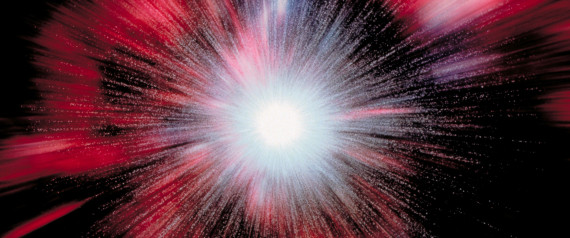
What if the universe had no beginning, and time stretched back infinitely without a big bang to start things off? That's one possible consequence of an idea called "rainbow gravity," so-named because it posits that gravity's effects on spacetime are felt differently by different wavelengths of light, aka different colors in the rainbow.
Rainbow gravity was first proposed 10 years ago as a possible step toward repairing the rifts between the theories of general relativity (covering the very big) and quantum mechanics (concerning the realm of the very small). The idea is not a complete theory for describing quantum effects on gravity, and is not widely accepted. Nevertheless, physicists have now applied the concept to the question of how the universe began, and found that if rainbow gravity is correct, spacetime may have a drastically different origin story than the widely accepted picture of the big bang.
According to Einstein's general relativity, massive objects warp spacetime so that anything traveling through it, including light, takes a curving path. Standard physics says this path shouldn't depend on the energy of the particles moving through spacetime, but in rainbow gravity, it does. "Particles with different energies will actually see different spacetimes, different gravitational fields," says Adel Awad of the Center for Theoretical Physics at Zewail City of Science and Technology in Egypt, who led the new research, published in October in the Journal of Cosmology and Astroparticle Physics. The color of light is determined by its frequency, and because different frequencies correspond to different energies, light particles (photons) of different colors would travel on slightly different paths though spacetime, according to their energy.
The effects would usually be tiny, so that we wouldn't notice the difference in most observations of stars, galaxies and other cosmic phenomena. But with extreme energies, in the case of particles emitted by stellar explosions called gamma-ray bursts, for instance, the change might be detectable. In such situations photons of different wavelengths released by the same gamma-ray burst would reach Earth at slightly different times, after traveling somewhat altered courses through billions of light-years of time and space. "So far we have no conclusive evidence that this is going on," says Giovanni Amelino-Camelia, a physicist at the Sapienza University of Rome who has researched the possibility of such signals. Modern observatories, however, are just now gaining the sensitivity needed to measure these effects, and should improve in coming years.
The extreme energies needed to bring out strong consequences from rainbow gravity, although rare now, were dominant in the dense early universe, and could mean things got started in a radically different fashion than we tend to think. Awad and his colleagues found two possible beginnings to the universe based on slightly different interpretations of the ramifications of rainbow gravity. In one scenario, if you retrace time backward, the universe gets denser and denser, approaching an infinite density but never quite reaching it. In the other picture the universe reaches an extremely high, but finite, density as you look back in time and then plateaus. In neither case is there a singularity—a point in time when the universe is infinitely dense—or in other words, a big bang. "This was, of course, an interesting result, because in most cosmological models, we have singularities," Awad says. The result suggests perhaps the universe had no beginning at all, and that time can be traced back infinitely far.
Whereas it is too soon to know if these scenarios might describe the truth, they are intriguing. "This paper and a few other papers show there could be a rightful place in cosmology for this idea [of rainbow gravity], which is encouraging to me," says Amelino-Camelia, who was not involved in the study, but has researched frameworks for pursuing a quantum theory of gravity. "In quantum gravity we are finding more and more examples where there is this feature which you may call rainbow gravity. It is something that is increasingly compelling."
Yet the concept has its critics. "It's a model that I do not believe has anything to do with reality," says Sabine Hossenfelder of the Nordic Institute for Theoretical Physics. This idea is not the only way to do away with the big bang singularity, she adds. "The problem isn't to remove the singularity, the problem is to modify general relativity in a consistent way, so that one still reproduces all its achievements and that of the Standard Model [of particle physics] in addition."
Lee Smolin of the Perimeter Institute for Theoretical Physics in Ontario, who first suggested the idea of rainbow gravity along with Joao Magueijo of Imperial College London, says that, in his mind, rainbow gravity has been subsumed in a larger idea called relative locality. According to relative locality, observers in different locations across spacetime will not agree on where events take place—in other words, location is relative. "Relative locality is a deeper way of understanding the same idea" as rainbow gravity, Smolin says. The new paper by Awad and his colleagues "is interesting," he adds, "but before really believing the result, I would want to redo it within the framework of relative locality. There are going to be problems with locality the way it's written that the authors might not be aware of."
In the coming years researchers hope to analyze gamma-ray bursts and other cosmic phenomena for signs of rainbow gravity effects. If they are found, it could mean the universe has a more "colorful" history than we knew.
Rainbow gravity was first proposed 10 years ago as a possible step toward repairing the rifts between the theories of general relativity (covering the very big) and quantum mechanics (concerning the realm of the very small). The idea is not a complete theory for describing quantum effects on gravity, and is not widely accepted. Nevertheless, physicists have now applied the concept to the question of how the universe began, and found that if rainbow gravity is correct, spacetime may have a drastically different origin story than the widely accepted picture of the big bang.
According to Einstein's general relativity, massive objects warp spacetime so that anything traveling through it, including light, takes a curving path. Standard physics says this path shouldn't depend on the energy of the particles moving through spacetime, but in rainbow gravity, it does. "Particles with different energies will actually see different spacetimes, different gravitational fields," says Adel Awad of the Center for Theoretical Physics at Zewail City of Science and Technology in Egypt, who led the new research, published in October in the Journal of Cosmology and Astroparticle Physics. The color of light is determined by its frequency, and because different frequencies correspond to different energies, light particles (photons) of different colors would travel on slightly different paths though spacetime, according to their energy.
The effects would usually be tiny, so that we wouldn't notice the difference in most observations of stars, galaxies and other cosmic phenomena. But with extreme energies, in the case of particles emitted by stellar explosions called gamma-ray bursts, for instance, the change might be detectable. In such situations photons of different wavelengths released by the same gamma-ray burst would reach Earth at slightly different times, after traveling somewhat altered courses through billions of light-years of time and space. "So far we have no conclusive evidence that this is going on," says Giovanni Amelino-Camelia, a physicist at the Sapienza University of Rome who has researched the possibility of such signals. Modern observatories, however, are just now gaining the sensitivity needed to measure these effects, and should improve in coming years.
The extreme energies needed to bring out strong consequences from rainbow gravity, although rare now, were dominant in the dense early universe, and could mean things got started in a radically different fashion than we tend to think. Awad and his colleagues found two possible beginnings to the universe based on slightly different interpretations of the ramifications of rainbow gravity. In one scenario, if you retrace time backward, the universe gets denser and denser, approaching an infinite density but never quite reaching it. In the other picture the universe reaches an extremely high, but finite, density as you look back in time and then plateaus. In neither case is there a singularity—a point in time when the universe is infinitely dense—or in other words, a big bang. "This was, of course, an interesting result, because in most cosmological models, we have singularities," Awad says. The result suggests perhaps the universe had no beginning at all, and that time can be traced back infinitely far.
Whereas it is too soon to know if these scenarios might describe the truth, they are intriguing. "This paper and a few other papers show there could be a rightful place in cosmology for this idea [of rainbow gravity], which is encouraging to me," says Amelino-Camelia, who was not involved in the study, but has researched frameworks for pursuing a quantum theory of gravity. "In quantum gravity we are finding more and more examples where there is this feature which you may call rainbow gravity. It is something that is increasingly compelling."
Yet the concept has its critics. "It's a model that I do not believe has anything to do with reality," says Sabine Hossenfelder of the Nordic Institute for Theoretical Physics. This idea is not the only way to do away with the big bang singularity, she adds. "The problem isn't to remove the singularity, the problem is to modify general relativity in a consistent way, so that one still reproduces all its achievements and that of the Standard Model [of particle physics] in addition."
In the coming years researchers hope to analyze gamma-ray bursts and other cosmic phenomena for signs of rainbow gravity effects. If they are found, it could mean the universe has a more "colorful" history than we knew.
Tuesday, December 10, 2013
Sound and Ancient Man, something to think about before you read a book review I will be posting
December 10, 2013




Stonehenge Sound Study Suggests Iconic Rocks Were Picked For Their Acoustic Properties (VIDEO)
The Huffington Post | By Macrina Cooper-White Posted: 12/09/2013 5:19 pm EST | Updated: 12/10/2013 7:42 am EST
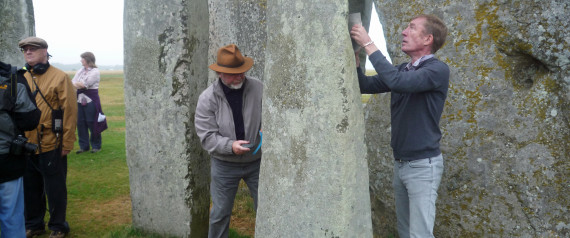
Of all the stones the ancients could have chosen to use in building Stonehenge, why did they pick those famous bluestones?
A provocative new study suggests it's because of their special acoustic qualities. The study adds a surprising twist to previous research that revealed Stonehenge may have been used as a concert venue.
For the study, researchers at the Royal College of Art in London tapped on more than 1,000 rocks in the Carn Menyn area of the Preseli Hills in southwestern Wales, the region where the iconic monument's bluestones are believed to have come from.
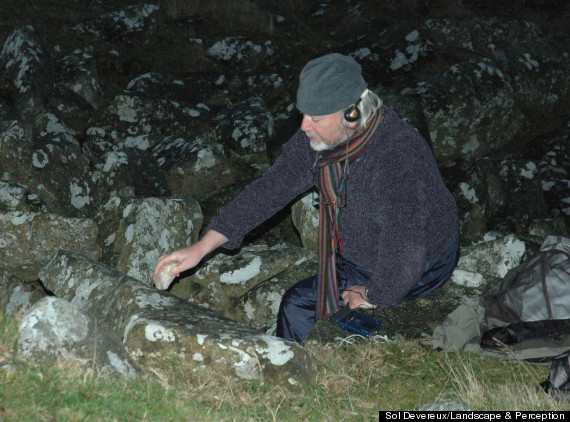
Researcher Paul Devereux uses percussion to test the sonic properties of a stone.
"We found it was a noteworthy soundscape, with a significant percentage of the actual rocks making metallic sounds like bells, gongs, tin drums, etc., when tapped with small, handheld 'hammerstones,'" study co-leader Paul Devereux, a research associate at the college and an expert in archaeo-acoustics, told The Huffington Post in an email.
Want to hear what the rocks sound like? Check out this video:
(Story continues below)
In July, the researchers gained clearance to conduct tests on the rocks at the Stonehenge site itself. They found the stones produced "distinctive if muted sounds, suggesting that they would have probably been full 'ringers' if they had the resonant space around them," Devereux and his collaborator wrote in an article describing the study.
Markings found on the Stonehenge rocks suggest that ancient people struck them -- but it's unclear whether the people were trying to make pretty sounds or simply breaking off bits of the rocks to keep as souvenirs, the researchers said.
"The stones may have been thought to have magical, qualities, mana, because of their exceptional sonic nature," Devereux told HuffPost Science, adding that even if the stones did not produce their own "rock music," they may have been revered for their sound qualities.
The study was published Dec. 2 in the journal Time and Mind: The Journal of Archaeology, Consciousness and Culture.
Subscribe to:
Posts (Atom)